
Answer: Adhering to healthcare marketing guidelines 2026 requires aligning all digital campaigns with the National Medical Commission (NMC) guidelines issued on 6 October 2026, ASCI truthfulness codes, and the DPDP Rules 2025. Promotional patient testimonials, before-and-after photos, “100% cure” promises, and “best doctor” claims are strictly prohibited. Ethical healthcare marketing must focus on verified doctor credentials, evidence-based patient education, and compliant digital infrastructure.
Download PDF Guideline- Healthcare Marketing Guideline 2026
Executive Summary & Key Takeaways
- The 6 October 2026 NMC Watershed: The National Medical Commission issued comprehensive Guidelines on Ethical Advertising and Public Communication by Hospitals/Medical Institutions and Registered Medical Practitioners with immediate effect. Reviewing all active campaigns is now Priority #1.
- Prohibited Promotional Elements: Patient video testimonials used in ads, before-and-after procedural photos, patient success stories as commercial promotions, and claims of “100% success” or “guaranteed cure” must be removed immediately.
- Superlatives Are Banned: Promotional claims like “Best Doctor,” “No. 1 Clinic,” or “Top Specialist” violate statutory ethical codes.
- Doctor Electronic Identity Mandate: Registered Medical Practitioners (RMPs) must display their verified name, recognized medical degrees, and state medical council registration number on digital communications.
- Multi-Layered Regulation: India does not have a single healthcare marketing rule. Compliance requires harmonizing NMC ethics, ASCI advertising codes, the Drugs and Magic Remedies Act 1954, Digital Personal Data Protection (DPDP) Rules 2025, and platform policies across Google and Meta.
- Global Portfolios: International healthcare clients in the USA (FTC, HIPAA), UK (ASA/CAP, GMC), Australia (Ahpra), and Dubai/UAE (DHA, MOHAP) must be evaluated against their respective statutory frameworks.
1. The 2026 Regulatory Landscape: Why Healthcare Marketing Compliance Is Priority
For private clinics, nursing homes, and corporate hospitals, patient acquisition can no longer be outsourced to generalist agencies that treat healthcare like e-commerce or consumer retail.
In India, healthcare communication operates under a complex statutory intersection of professional medical ethics, statutory drug advertising acts, consumer protection regulations, and digital platform restrictions. In 2026, regulatory scrutiny reached an unprecedented peak. State Medical Councils, the Advertising Standards Council of India (ASCI), and consumer dispute commissions are actively issuing notices for non-compliant digital claims.
Simultaneously, Google and Meta have tightened algorithmic screening for health-related keywords, penalizing landing pages that make unverified clinical promises or assert sensitive medical conditions.
Understanding and operationalizing healthcare marketing guidelines 2026 is not merely a legal formality—it is the foundational prerequisite to protecting your clinical practice license, sustaining ad account health, and building an unassailable patient acquisition engine.
When partnering with a specialized AI healthcare digital marketing company in India, compliance is engineered into every headline, video script, schema markup, and patient follow-up workflow from Day 1.
2. Priority 1 Update: NMC Guidelines (Issued 6 October 2026)
The most consequential regulatory development in Indian medical history occurred on 6 October 2026, when the National Medical Commission (NMC) officially released the Guidelines on Ethical Advertising and Public Communication by Hospitals/Medical Institutions and Registered Medical Practitioners, taking effect immediately.
Consult the Official NMC Portal for the full statutory text. Every medical director and marketing team must conduct an emergency audit of all active campaigns against these mandates.
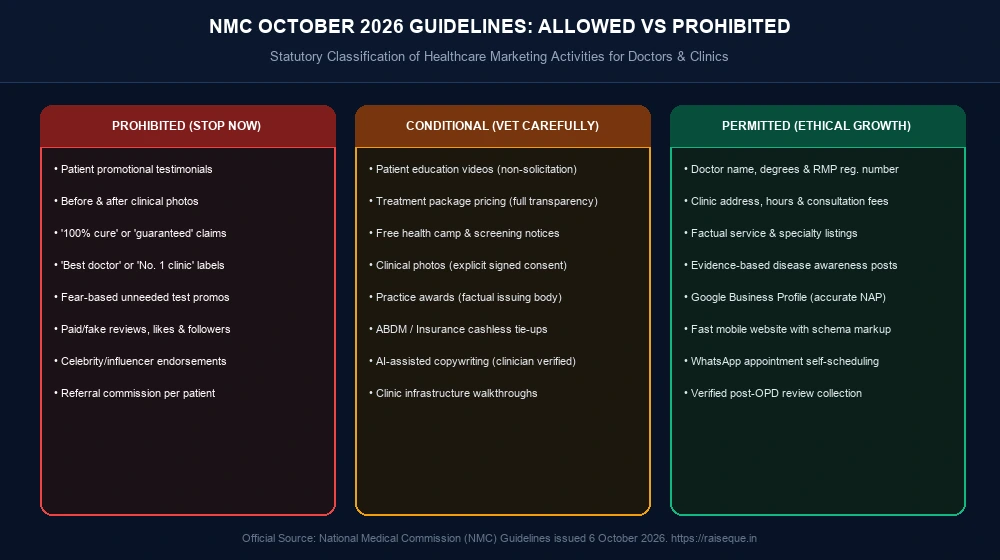
NMC Guidelines October 2026 Matrix
What to Stop, Review, or Restrict Immediately:
| S.N | Marketing Activity | Statutory Compliance Action | Regulatory Rationale |
|---|---|---|---|
| 01 | Patient Testimonials in Ads | STOP promotional use | Using patient testimonials in paid ads, boosted reels, or promotional flyers is strictly prohibited. |
| 02 | Before-and-After Photos | STOP promotional use | Comparative patient imagery implies guaranteed cosmetic or clinical outcomes and is barred from promotion. |
| 03 | Patient Success Stories as Ads | STOP promotional use | Commercializing patient recovery journeys as paid advertising collateral violates medical conduct codes. |
| 04 | “100% Success” or “Guaranteed Cure” | REMOVE immediately | Medicine has inherent biological variance; promising guaranteed cures or outcomes is illegal under medical ethics. |
| 05 | “Best Doctor,” “No. 1 Clinic,” “Top Specialist” | DO NOT USE | Superlative and comparative claims distort public perception and constitute prohibited commercial solicitation. |
| 06 | Fear-Based Advertising | STOP immediately | Campaign messaging that induces anxiety to drive unneeded diagnostics, blood panels, or elective surgeries is banned. |
| 07 | Paid or Fake Reviews & Followers | PROHIBITED | Purchasing artificial Google reviews, paid followers, synthetic likes, or bot comments constitutes illegal manipulation. |
| 08 | Celebrity & Influencer Endorsements | REVIEW & REMOVE | Engaging social media influencers or public figures to endorse clinical services or doctors is prohibited. |
| 09 | Discounts, Offers & Free Inducements | RESTRICT & AUDIT | Price-slashing promos, festive package discounts, and commercial inducements for medical procedures are restricted. |
| 10 | Referral Commissions Per Patient | STRICTLY PROHIBITED | Paying marketers, diagnostic labs, or partner clinics a per-patient acquisition commission violates anti-kickback ethics. |
| 11 | Doctors Endorsing Commercial Products | STOP endorsements | Registered physicians cannot publicly endorse pharmaceutical brands, surgical devices, or commercial health supplements. |
| 12 | Fake AI Patients & Synthetic Testimonials | STRICTLY PROHIBITED | Generating AI synthetic patients, virtual avatar testimonials, or fabricated treatment case studies is entirely illegal. |
Crucial Clarification: The NMC directive does not ban medical communication. Rather, it mandates a clean division between commercial patient solicitation (prohibited) and factual, evidence-based public health education (permitted).
3. NMC Social Media, Website & Agency Contract Requirements
Under the October 2026 NMC framework, digital assets must meet specific transparency and governance standards:
Operational Requirements for Clinics and Marketers:
| Digital Touchpoint | Statutory Requirement | Implementation Standard |
|---|---|---|
| Doctor Identity Verification | Full Legal Name & Verified Degrees | State only recognized medical qualifications listed under NMC schedules (e.g., MBBS, MD, MS, MCh, DNB). Unrecognized foreign certificates must not be presented as primary degrees. |
| Electronic Communications | Mandatory RMP Registration Display | Registered Medical Practitioners must display their Medical Council Registration Number (e.g., “State Medical Council Reg. No. XXXXX”) on doctor profile pages, website bios, and official video disclaimers. |
| Health Education Standards | Factual & Evidence-Based | Social content must focus on disease awareness, symptoms, preventive measures, and lifestyle guidance without commercial CTAs soliciting clinical consultations. |
| Clinic Website Information | Accurate Infrastructure Details | Display verifiable infrastructure data: clinical specialties offered, operation theatre standards, diagnostic lab accreditations, visiting hours, and transparent OPD consultation fees. |
| Clinical Visuals & Videos | Documented Informed Consent | Identifiable patient images used for legitimate academic or clinical documentation require explicit, auditable written consent. Such images must never be repurposed as promotional ad creative. |
| AI-Assisted Content | Clinician-Reviewed & Verified | While AI tools may assist in research and draft copywriting, all clinical facts must be reviewed and verified by a qualified doctor prior to publication. Fabricating patient scenarios using generative AI is strictly illegal. |
| Agency Contracts & SOPs | Documented Client Approval Gate | Agency involvement does not absolve the registered doctor or hospital of statutory liability. Agency contracts must stipulate written doctor sign-off before publishing and explicitly bar fee-per-patient compensation. |
4. Other Core Indian Healthcare Advertising Laws (ASCI, Drugs Act, DPDP)
Beyond the NMC notice, three foundational statutes govern healthcare communication in India:
1. ASCI Code of Advertising Standards
The Advertising Standards Council of India (ASCI) actively investigates consumer complaints against deceptive healthcare advertising. Key rules include:
- Substantiation of Claims: Any statistical claim (e.g., “95% patient satisfaction”, “over 10,000 successful surgeries”) must be backed by documented clinical audit records.
- Prohibition of Misleading Omissions: Disclose crucial treatment conditions, standard recovery timelines, and potential complications openly.
- Awards & Rankings Transparency: Do not cite unverified paid awards (e.g., “Awarded Best Cosmetic Surgeon by XYZ Media”). Only recognize awards granted by recognized government or statutory bodies.
2. Drugs and Magic Remedies (Objectionable Advertisements) Act, 1954
This federal statute bars advertising treatments, remedies, or medicines for specified conditions outlined in the Act’s schedule, including:
- Cures for sexual performance disorders, infertility, or reproductive enhancement.
- Non-surgical dissolution of kidney or gallstones.
- Guaranteed treatments for cancer, diabetes, epilepsy, and chronic autoimmune disorders.
- Compliance Mandate: Clinic marketing in fertility (IVF), sexual wellness, and ayurvedic/ayush integration must avoid cure claims that violate the Drugs and Magic Remedies Act 1954.
3. Digital Personal Data Protection (DPDP) Act 2023 & Rules 2025
Healthcare data is categorized as highly sensitive personal data under MeitY Digital Personal Data Protection Guidelines. Clinics face penalties up to ₹250 Crores for unauthorized data exposure:
- Explicit Digital Consent: Capturing patient names, phone numbers, or symptom details via website lead forms or WhatsApp requires clear, affirmative consent checkboxes.
- Purpose Limitation: Phone numbers collected for appointment scheduling cannot be dumped into third-party promotional SMS databases without opt-in.
- Public Privacy in Review Replies: Never acknowledge a reviewer’s clinical diagnosis or treatment history in public Google review responses (e.g., replying: “Thank you Mr. Sharma, glad your piles surgery went well” is a severe DPDP breach).
5. Google Ads & Meta Ads Healthcare Policy Playbook
Obtaining platform approval on Google or Facebook does not mean an ad complies with Indian medical laws. Marketers must pass both platform algorithms and statutory medical guidelines simultaneously.
┌────────────────────────────────────────────────────────────────────────┐
│               DUAL-GATE HEALTHCARE ADVERTISING APPROVAL                │
├───────────────────────────────────┬────────────────────────────────────┤
│ GATE 1: PLATFORM POLICIES         │ GATE 2: STATUTORY COMPLIANCE       │
│ • Google Healthcare Certification │ • NMC 6 Oct 2026 Notice            │
│ • No personal health assertions   │ • ASCI Truth in Advertising Code   │
│ • Prohibited pharmaceuticals list │ • DPDP Act 2023 Patient Consent    │
│ • Landing page speed & security   │ • Zero cure guarantees or 'Best'   │
└───────────────────────────────────┴────────────────────────────────────┘
Google Ads Healthcare & Medicines Policy:
- Prescription Medicines: Cannot bid on or mention scheduled pharmaceutical drugs in ad copy or display URLs.
- Healthcare Provider Certification: Certain regions require advertisers to complete Google’s healthcare provider verification.
- Landing Page Scrutiny: Google’s automated crawlers review the entire destination URL. If your landing page contains cure promises or non-compliant claims, your ad account faces suspension per Google Ads Healthcare Policy.
Meta Ads (Facebook & Instagram) Health Standards:
- No Assertion of Personal Health Conditions: Ad copy cannot directly address or imply the user suffers from a specific medical problem.
- ❌ Prohibited: “Are you struggling with severe depression or adult acne?”
- ✅ Compliant: “Understanding the causes of adult acne: 3 clinical tips by Dr. [Name], MD (Dermatology).”
- Zero Body Shaming or Fear Tactics: Ads must not induce negative body image, zoom into distressed physical flaws, or use scare tactics to sell procedures.
- Landing Page Alignment: Meta’s algorithm penalizes ad accounts whose landing pages trigger high bounce rates or display deceptive claims.
6. Local SEO, Google Business Profile (GBP) and Reviews Governance
Google Maps 3-Pack rankings account for over 50% of local outpatient decisions. However, manipulating your listing introduces severe regulatory and algorithmic risks.
Every practice utilizing Local SEO for Healthcare must enforce these ten operational controls:
Google Business Profile Governance Checklist:
| S.N | Inspection Area | Mandatory Operational Guideline |
|---|---|---|
| 01 | Business Name | Use the clinic’s real-world registered business name matching exterior signage. Never stuff specialty keywords (e.g., “Apex Clinic – Best Heart Doctor Ortho Surgeon” triggers immediate suspension). |
| 02 | Primary Category | Select the exact specialized category (e.g., “Pediatrician” or “Dental Clinic” rather than the broad “Medical Clinic”). |
| 03 | Services Listed | List only treatments and diagnostic services actively performed on the clinic premises. |
| 04 | Doctor Profiles | Verify doctor degrees recognized under the NMC register and link verified physician schemas. |
| 05 | Zero Review Buying | Never purchase reviews, engage click farms, or incentivize reviews with gifts or fee discounts. |
| 06 | Review Replies Privacy | Maintain strict clinical privacy in review replies. Never confirm medical procedures, symptoms, or diagnoses publicly. |
| 07 | Review Reposting Rules | Comply with the NMC 6 October directive by refraining from turning patient reviews into promotional social ads. |
| 08 | Authentic Photos | Upload high-resolution, geo-tagged images of clinic reception, OT facilities, doctor consultation rooms, and exterior signage. Avoid stock photography. |
| 09 | Landing Page NAP | Maintain 100% exact consistency of Name, Address, and Phone across your website footer, Practo, Justdial, and Google Business Profile. |
| 10 | Transparent Reporting | Track organic impressions, verified phone calls, and direction requests; never inflate metrics with fabricated rank tracking. |
7. Healthcare Content, Reels & Doctor Video Pre-Publication Checklist
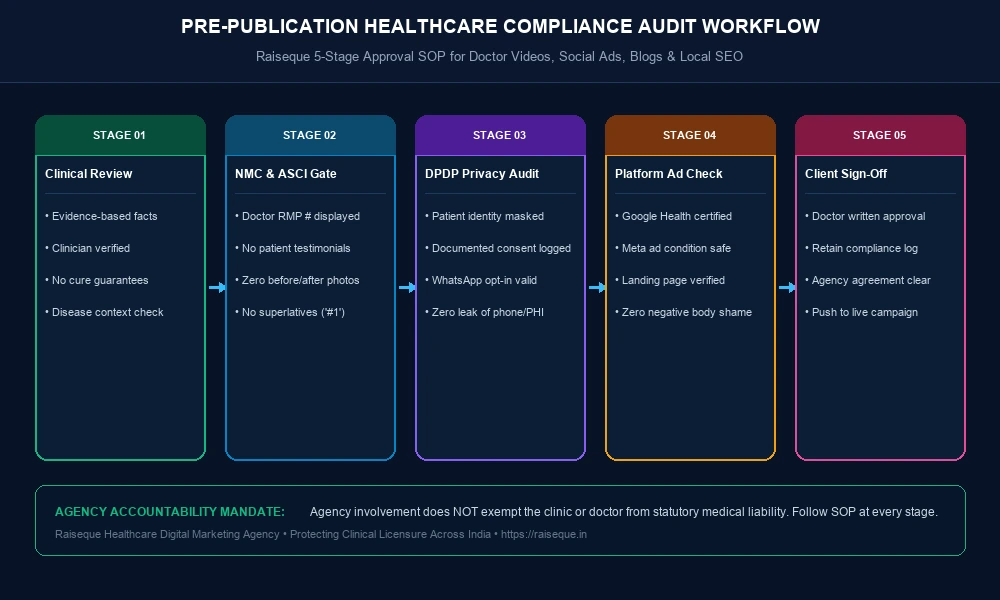
Pre-Publication Healthcare Compliance Flowchart
Before publishing any Instagram Reel, YouTube Short, blog post, or doctor interview, run the creative through this 10-Point Pre-Publication Gate:
Pre-Publication Compliance Gate (Mandatory Audit Score: 10 / 10)
| Gate S.N | Pre-Publication Compliance Checkpoint | Mandatory Verification Standard | Statutory & Platform Authority | Audit Sign-Off |
|---|---|---|---|---|
| 01 | Clinical & Scientific Review | Medical claims, clinical protocols, and health advice are vetted and approved in writing by a verified Registered Medical Practitioner (RMP). | NMC Registered Practitioner Code / Google YMYL E-E-A-T | [ ] PASS |
| 02 | Zero Outcome & Cure Guarantees | Total prohibition of “100% cure”, “guaranteed pain relief”, “permanent results”, or unsubstantiated percentage success metrics. | Drugs and Magic Remedies Act, 1954 / ASCI Chapter I | [ ] PASS |
| 03 | Zero Promotional Testimonials | Strict elimination of patient review videos, before/after procedural photos, transformation reels, and celebrity endorsements. | NMC Guidelines (6 October 2026) Sec 4.1 | [ ] PASS |
| 04 | Zero Fear-Based / Alarmist Messaging | Creatives must not induce anxiety, exaggerate disease complications, or use emotional coercion to drive unneeded diagnostic tests or surgery. | Consumer Protection Act, 2019 / ASCI Medical Code | [ ] PASS |
| 05 | Zero Synthetic / Fake AI Media | Total ban on AI-generated patient avatars, fabricated case studies, cloned voices, fake consultation simulations, or bot-generated reviews. | NMC 2026 AI Ethics Directive / MeitY IT Rules 2021 | [ ] PASS |
| 06 | Patient Privacy & PHI Protection | Zero disclosure of patient names, faces, clinical case sheets, lab reports, or health history without explicit written consent. | Digital Personal Data Protection (DPDP) Act, 2023 | [ ] PASS |
| 07 | Mandatory Doctor Credentials Display | Electronic creatives & bios must prominently display the doctor’s full legal name, university qualifications, and State Medical Council RMP number. | NMC Digital Communication Mandate 2026 | [ ] PASS |
| 08 | Ad Network Policy Alignment | Ad copy, landing pages, and lead forms comply with Meta Personal Health Attributes Policy and Google Healthcare Advertising Certification. | Meta Advertising Standards & Google Ads Policy | [ ] PASS |
| 09 | Zero Commercial Inducements & Fee-Splitting | No doctor endorsements of commercial pharma/devices, no treatment discounts or packages, and zero per-patient referral payouts. | NMC Professional Conduct Regulations & Ethics SOP | [ ] PASS |
| 10 | Documented Institutional Leadership Approval | Formal sign-off archived in clinic audit log from the Medical Superintendent or Clinic Lead prior to public scheduling or deployment. | Clinical Establishments Act & ISO/NABH Audit SOP | [ ] PASS |
Operational Rule: If a creative scores 9/10, it does not go live. A single non-compliant claim can trigger a State Medical Council summons.
8. Special Compliance Rules by Clinical Specialty
Different clinical disciplines face unique statutory hazards:

Specialty Compliance Risk Dashboard
Alt: Healthcare compliance risk audit across specialties: IVF, Dermatology, Orthopaedics, Dental, Hospitals
1. Dental Practices
- High-Risk Claims: Promising “100% Painless Dentistry,” guaranteed teeth whitening shades, or lifetime implant guarantees.
- Compliance Standard: Focus on clinical precision, sterilisation protocols, dental hygiene education, and 3D intraoral scanner walkthroughs.
2. Dermatology & Aesthetic Clinics
- High-Risk Claims: Manipulated before-and-after acne scar photos, skin lightening promises, promoting injectable brands (e.g., Botox/fillers by commercial trade names).
- Compliance Standard: Frame content around medical skin pathology (acne causes, eczema triggers, sun protection science). Refer to treatments by generic scientific terms (“anti-wrinkle neuromodulator injections”).
3. IVF & Fertility Centers
- High-Risk Claims: Claiming “90% IVF Success Rates,” “Guaranteed Conception Packages,” or advertising prenatal gender selection (strictly barred under the PCPNDT Act and the Assisted Reproductive Technology Act 2021).
- Compliance Standard: Deliver compassionate educational content explaining AMH levels, male factor evaluations, embryo freezing science, and transparent cycle stage walkthroughs.
4. Orthopaedics & Spine Centers
- High-Risk Claims: Promising “Zero Pain Joint Replacements,” guaranteed return to sports in 2 weeks, or endorsing specific prosthetic joint implant brands.
- Compliance Standard: Educate patients on conservative therapy indications, surgical safety standards, modular laminar airflow OTs, and structured post-operative physiotherapy recovery.
5. Multi-Specialty Hospitals
- High-Risk Claims: Advertising “Best Hospital in Eastern India,” unverified emergency survival rates, or deceptive “Free Health Checkup” camps with hidden commercial caveats.
- Compliance Standard: Highlight multi-disciplinary team credentials, NABH accreditation standards, cashless TPA processing, and verified medical technology infrastructure.
6. Paediatric Clinics
- High-Risk Claims: Publishing children’s photos without legal guardian consent, making developmental milestone guarantees.
- Compliance Standard: Follow strict DPDP Act child data protection rules. Provide evidence-based immunization calendars and seasonal infection guidance.
9. International Healthcare Marketing Compliance (USA, UK, Australia, Dubai)
If your healthcare practice treats international medical tourists or operates across borders, India’s rules cannot be your only benchmark:
| Target Market | Primary Regulatory Authorities | Critical Compliance Framework |
|---|---|---|
| India | National Medical Commission (NMC), ASCI, MeitY | 6 October 2026 NMC Directive, ASCI Truthfulness Code, DPDP Rules 2025. |
| United States (USA) | Federal Trade Commission (FTC), State Medical Boards, HHS | FTC Health Advertising Substantiation Guides, strict HIPAA patient confidentiality, state-specific medical board advertising rules. |
| United Kingdom (UK) | Advertising Standards Authority (ASA), GMC, ICO | ASA/CAP Code rules for medical marketing, General Medical Council (GMC) ethical guidance, UK GDPR data privacy. |
| Australia | Australian Health Practitioner Regulation Agency (Ahpra) | Ahpra Advertising Guidelines under the Health Practitioner Regulation National Law (bans testimonials and gifts). |
| Dubai / UAE | Dubai Health Authority (DHA), Ministry of Health (MOHAP) | Mandatory DHA Health Advertisement Approval Permit prior to running any digital ad, UAE Federal Data Privacy Law. |
Action Rule: Never run an Indian ad creative in the UAE or USA without auditing it against that country’s specific health advertising statutes.
10. Raiseque 5-Step Implementation SOP for Clinics and Hospitals
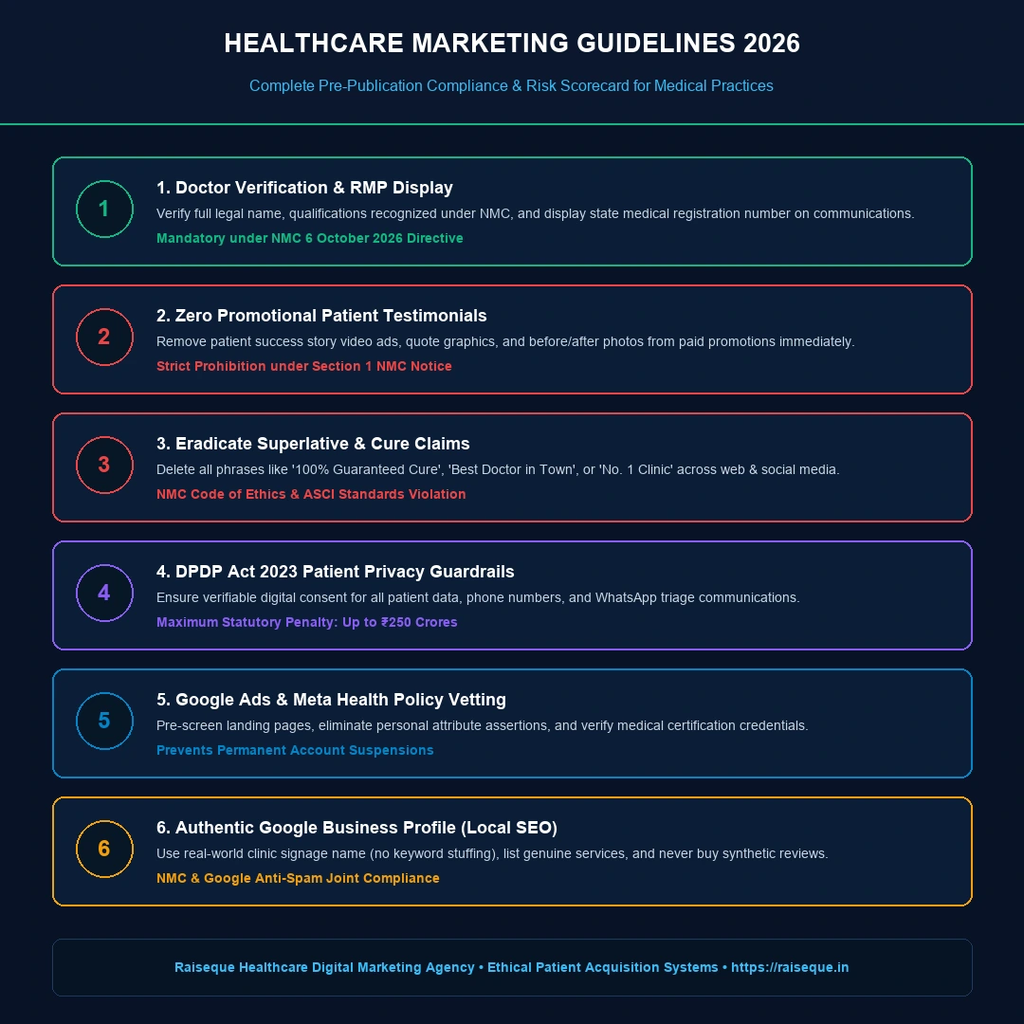
Healthcare Marketing Checklist 2026 Scorecard
Alt: 2026 healthcare marketing guidelines checklist scorecard: 6 strategic compliance checkpoints
Raiseque recommends executing this 5-step compliance transition immediately:
Step 1: Comprehensive Digital Footprint Audit
Conduct a complete inventory audit of all historical digital assets: active website pages, past blogs, Instagram/YouTube reels, Facebook ads, Google Business Profile posts, and automated WhatsApp templates. Flag and archive every creative containing patient testimonials, before/after photos, superlatives (“Best/No. 1”), or unverified cure claims.
Step 2: Establish a Prohibited-Claims Library
Create an internal compliance manual cataloging approved vs. prohibited terminology for your front-desk staff, copywriters, and doctors. Ensure everyone understands why claims like “100% painless” are banned.
Step 3: Implement Documented Clinician Sign-Off
Institute a mandatory pre-publication sign-off protocol. No piece of medical content goes live without written or auditable digital approval from the practice director or a registered physician.
Step 4: Re-engineer Agency Contracts
Review marketing agency contracts. Ensure legal indemnity clauses, eliminate any compensation models tied to per-patient referral commissions, and mandate adherence to NMC 2026 standards.
Step 5: Deploy the Compliant Patient Acquisition System
Shift from risky form-lead ads to Raiseque’s proprietary Patient Acquisition System—combining high-intent Google Search authority, verified Google Maps 3-Pack optimization, and automated WhatsApp appointment booking with full DPDP consent logging.
11. Frequently Asked Questions (FAQs)
Did the NMC ban all digital marketing for doctors on 6 October 2026?
No. The NMC guidelines issued on 6 October 2026 do not ban digital communication. Rather, they prohibit aggressive commercial solicitation—such as promotional patient testimonials, before-and-after photos, “100% cure” guarantees, and “best doctor” superiority claims. Factual institutional information, verified doctor credentials, and non-promotional, evidence-based public health education remain permitted.
Can clinics use patient reviews on Google Maps under 2026 guidelines?
Yes, Google Business Profile reviews are natural user-generated feedback. However, practices must never purchase fake reviews, incentivize reviews with discounts, or turn patient reviews into promotional video ads or graphic posters. Furthermore, review replies must never disclose a patient’s medical details or diagnosis, complying with DPDP Act 2023 privacy rules.
How do healthcare marketing guidelines 2026 affect Instagram Reels and YouTube Shorts?
Doctor-led video reels are highly effective when framed as public health education. Doctors can explain disease causes, debunk misconceptions, and outline clinical preventive measures while displaying their recognized degrees and state RMP registration number. However, video reels must not include patient testimonials, before-and-after transformations, or aggressive sales CTAs soliciting consultations.
What are the consequences of violating healthcare marketing guidelines in India?
Violations can trigger disciplinary proceedings from State Medical Councils (including temporary suspension or permanent cancellation of a doctor’s medical registration), statutory penalties from consumer protection commissions, legal notices under the Drugs and Magic Remedies Act, and permanent ad account bans from Google and Meta.
How does Raiseque ensure 100% compliance for healthcare clients?
Raiseque integrates statutory compliance into every deliverable through a 5-stage pre-publication audit gate. Every campaign is reviewed by our Medical Advisory Board against NMC ethical guidelines, ASCI truthfulness codes, and DPDP privacy rules, ensuring medical practices achieve predictable patient footfalls without risking their clinical license.
12. Conclusion: Ethical Growth as a Practice Moat
The release of the National Medical Commission’s October 2026 directives marks a permanent transformation in Indian healthcare marketing. The era of cheap marketing tricks, exaggerated cure guarantees, and fabricated patient testimonials is officially over.
Far from being a barrier, healthcare marketing guidelines 2026 present a formidable competitive advantage for forward-thinking doctors and hospital leaders. When unethical competitors receive medical council warnings and ad account suspensions, practices that commit to authentic, evidence-based, compliant communication will build enduring patient trust and compounding market authority.
By harmonizing clinical excellence, verifiable doctor authority, and compliant digital systems, your practice can achieve sustainable patient footfall while safeguarding its reputation for decades to come.
Are you ready to audit your practice’s digital marketing compliance?
👉 Request a Free Practice Digital Audit at Raiseque — Our healthcare growth strategists and medical advisory team will conduct a comprehensive compliance audit of your website, ads, Google Maps listing, and social media footprint, delivering an actionable, NMC-compliant growth roadmap.